The Tummala Model of Health is a physician-built, evidence-based framework that treats your health as seven connected pillars: nutrition, physical activity, sleep, stress, social connection, substance use, and reproductive health. Each pillar is measured, and each is optimized in a deliberate order. Behavior first, then targeted supplements, then medications when they are clinically warranted.
You have probably been told to “eat better” and “manage your stress” a hundred times. What you were rarely handed is a structure that shows how those pieces actually fit together. That structure is what this article gives aims to give you.
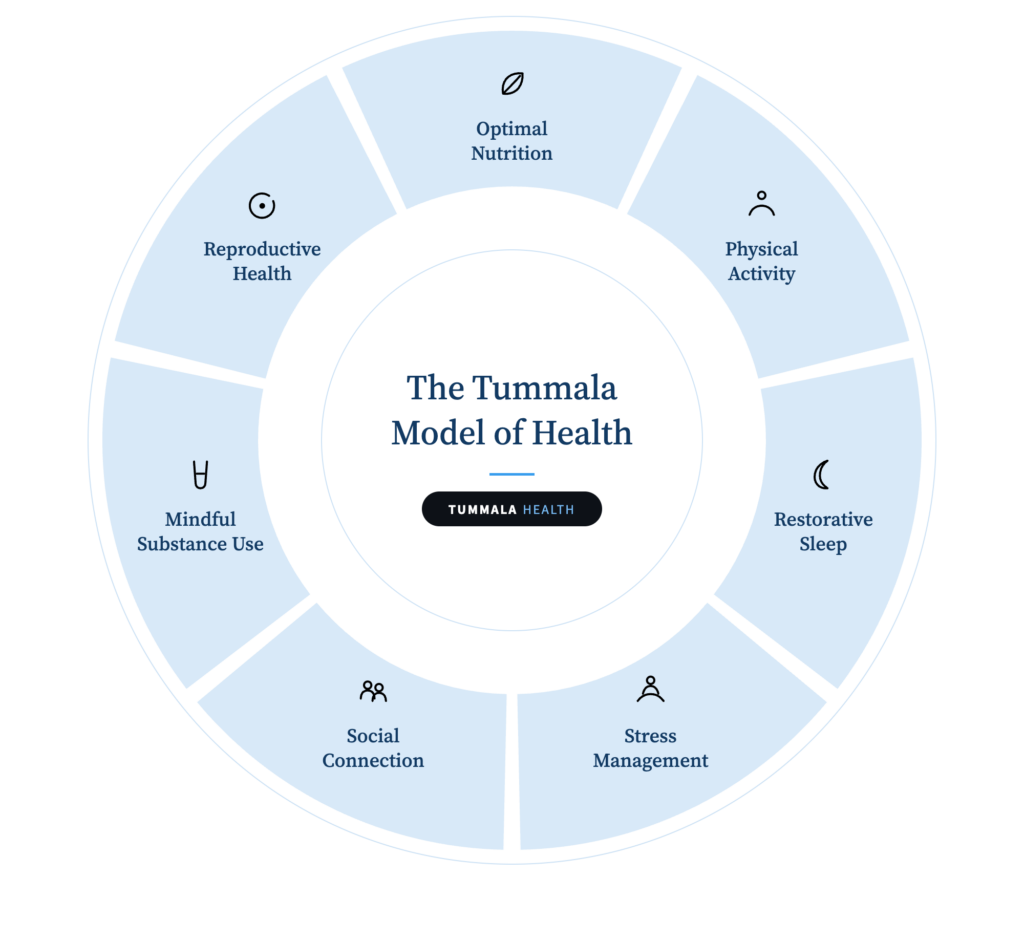
An Overview of the Tummala Model of Health
A model of health is essentially a map. It helps you understand the components of optimal health and how they are truly symbiotic with each other. Addressing deficiencies helps address long-term risk factors. Most people never get the map. They get slogans from an influencer or rushed conversation with a doctor.
The Tummala Model exists to fill that gap and help educate you on the components of sustainable, long-term health and vitality. It is a health framework built to empower you on how to take control of your well-being. The goal is not to replace your doctor. It is to give you a way to think about your own health that makes your next conversation with your doctor sharper.
What are the seven pillars of the Tummala Model of Health?
The seven pillars are the domains where the strongest evidence sits for staying well over a lifetime. Here is each one, and why it earns a place.
1. Optimal Nutrition. What you eat is one of the largest modifiable influences on your health. Globally, dietary risks consistently rank among the leading contributors to death and disability across countries, underscoring how central nutrition is to long-term vitality.[1] One US burden analysis estimated that suboptimal intake of ten dietary factors was associated with about 45% of all US cardiometabolic deaths in a single year, with high sodium, low nuts and seeds, and high processed meats among the largest individual contributors.[2]
2. Physical Activity. Regular movement protects your heart, maintaines your muscle, and is a critical factor in vitality. National prevention guidance recommends at least 150 minutes a week of moderate aerobic activity, or 75 minutes of vigorous activity, plus resistance training for optimal glucose control and physical function.[3]
3. Restorative Sleep. Sleep is not downtime, it is maintenance. Reduced sleep is associated with a higher risk of coronary heart disease, stroke, an major disease burden in large pooled studies.[4] Emerging research also points to cognitive health as another reason to take sleep duration seriously. Both too little and too much sleep track with worse outcomes, and the healthiest range sits around 7 to 9 hours.[5]
4. Stress Management. Chronic psychological stress is not “just in your head”, it plays an important role in increasing the risk of chronic disease. In a large international study, sustained work or home stress was associated with roughly double the odds of a first heart attack and plays a role in a number of different chronic diseases.[6]
5. Social Connection. Loneliness and isolation also carry measurable health risk. A meta-analysis of 90 cohort studies covering more than two million people found social isolation was associated with a higher risk of death from all causes.[7]
6. Mindful Substance Use. Alcohol, tobacco, and other substances are among the risk factors that most sharply raise the odds of chronic disease and early death, which is why the Tummala Health framework lists avoiding risky substances as a core pillar.[8]
7. Reproductive Health. Sexual health, fertility, and hormones across the lifespan interact with the other pillars. In polycystic ovary syndrome, for example, diet and physical activity are recommended as first-line management, which shows how tightly reproductive health is woven into overall physiologic health.[9]
How the Pillars Lean on Eachother
The pillars of the Tummala Model of Health are an interconnected web all interdependent on each other. This is the part most health advice never explains. Deficiencies in one of the pillars affects the other ones more than you would think.
Poor sleep raises stress hormones. Chronic stress activates your stress-response system in a way that promotes insulin resistance, belly fat, and higher blood pressure.[10] Social isolation raises inflammation and mortality risk independent of mood.[7] When one pillar weakens, it quietly drags its neighbors down. When several pillars are strengthened together, the combined benefit is greater than what any single change can produce on its own. That is what “whole-person” actually means here. It is a description of an interconnected model of human health.
I think of one patient who came in to see me for chronic shoulder pain. The pain kept him up at night, and once his sleep fell apart, everything else started to slide with it. He was more stressed and shorter-tempered during the day. He stopped exercising because he was too tired and sore to want to. And by evening he was reaching for whatever was easy and comforting to eat, not what he would have chosen on a good week. On paper he looked like four separate problems: a shoulder problem, a sleep problem, a stress problem, and a nutrition problem. They were really one thread. When we finally got his pain and his sleep under control, the stress eased, the workouts came back, and the late-night eating quietly faded on its own.
Seeing the web changes what you do and how you approach your health.
What is the Tummala Model of Health based on?
It is built on the evidence base of lifestyle medicine, and it grades that evidence honestly. The seven pillars line up closely with the pillars a clinical practice guideline from the American College of Lifestyle Medicine uses for managing and preventing type 2 diabetes: nutrition, physical activity, stress management, sleep, social connectedness, and avoiding risky substances.[8]
Our goal here is to present the evidence to you. Not to claim certainty everywhere, but to show you exactly where the evidence is strong and where it is still emerging and how you can use these data points to improve your health.
How is this different from functional or integrative medicine?
The Tummala Model is not functional medicine relabeled. We do not sell unvalidated “root cause” testing, and we do not treat behavior as a last resort after a shelf of supplements. Whole-person and evidence-based are not opposites in this model. The pillars interact because human biology interacts, and we hold every recommendation to the evidence.
In what order should you optimize the pillars?
In a deliberate ladder, from the strongest and safest lever to the most targeted.
1. Behavior first. Nutrition, movement, sleep, stress, connection, and substance use are where the strongest, safest evidence lives. This is the foundation, always.
2. Targeted supplements second. When a specific gap remains or when you need a boost to help you get going, a supplement can support normal function. For example supporting muscle recovery, sleep or anxiety. Supplements are structural and function support. They are not stand-ins for treating disease alone.
3. Medications third, when clinically indicated. Some situations genuinely call for a prescription. That decision belongs to you and your own clinician, weighing risks and benefits. A medication is matched support on top of the foundation, never a shortcut that lets you skip it.
This ladder is why the model is neither supplements-first nor pills-first. It is behavior-first, with precision tools stacked on top in order.
How do you actually start using the model?
Start by taking stock of your habits, then reflect, then start by intervening on your weakest pillar. That measure-reflect-intervene loop is ordinary clinical reasoning, made visible so you can run it on yourself. Don’t worry, we are here to help you through it.
- Measure. Take stock of your vitality signs across all seven pillars.
- Reflect. Look at which pillar is weakest, and which one you suspect is dragging the others down.
- Intervene. Pick that one pillar and apply the ladder. Behavior first, then targeted support and conversation with your clinician if a medication is warranted.
Tummala Health is here with you every step of the way.
FAQ
Is “holistic” just code for unscientific?
No. In this model, whole-person is a statement about biology, not a rejection of science. The pillars interact because your body’s systems interact. For example, poor sleep raises stress, and stress worsens metabolic health in an integrated way.[10] This is just an example of the many ways your health interacts.
Is this trying to replace my doctor?
No. The Tummala Model is a framework for understanding your own health and a starting point for better conversations. It is education to empower you, not individualized medical advice. For anything about your diagnosis, medications, or symptoms, talk with your own physician.
Does the model push supplements or medications first?
No. The order is behavior first, then targeted supplements as structure and function support, then medications only when they are clinically indicated. Supplements are not disease treatments, and no one should assume a medication is right for them.
What is the single most important pillar?
There is no universal answer, and that is the point. The pillar that matters most for you is your weakest one, because it tends to drag the others down. Measuring across all seven is how you find it.
How strong is the evidence behind the pillars?
It varies by pillar and topic within it, and we show that openly.
Follow the series
The Tummala Model of Health is what our educational content is built on. Follow the launch-week series where we take each pillar apart with the evidence, tier by tier.
Leave a comment! Of the seven pillars, which one is your weakest right now, and which do you think secretly drags the others down?
For anything about your own diagnosis, medications, or symptoms, talk to your physician. This is education, not personal medical advice.
References
1. Anon. Global burden of 87 risk factors in 204 countries and territories, 1990-2019: a systematic analysis for the Global Burden of Disease Study 2019. Lancet (London, England) 2020. Tier C. PMID 33069327.
2. Micha R, et al. Association Between Dietary Factors and Mortality From Heart Disease, Stroke, and Type 2 Diabetes in the United States. JAMA 2017. Tier C. PMID 28267855.
3. Arnett DK, et al. 2019 ACC/AHA Guideline on the Primary Prevention of Cardiovascular Disease. Circulation 2019. Tier B. PMID 30879355.
4. Cappuccio FP, et al. Sleep duration predicts cardiovascular outcomes: a systematic review and meta-analysis of prospective studies. European Heart Journal 2011. Tier A. PMID 21300732.
5. Li J, et al. Sleep duration and health outcomes: an umbrella review. Sleep & Breathing 2022. Tier A. PMID 34435311.
6. Yusuf S, et al. Effect of potentially modifiable risk factors associated with myocardial infarction in 52 countries (INTERHEART Study). Lancet 2004. Tier B. PMID 15364185.
7. Wang F, et al. A systematic review and meta-analysis of 90 cohort studies of social isolation, loneliness and mortality. Nature Human Behaviour 2023. Tier A. PMID 37337095.
8. Rosenfeld RM, et al. Lifestyle Interventions for Treatment and Remission of Type 2 Diabetes and Prediabetes in Adults: A Clinical Practice Guideline From the American College of Lifestyle Medicine. American Journal of Lifestyle Medicine 2025. Tier B. PMID 40546761.
9. Kazemi M, et al. Comparison of dietary and physical activity behaviors in women with and without polycystic ovary syndrome: a systematic review and meta-analysis of 39,471 women. Human Reproduction Update 2022. Tier A. PMID 35639552.
10. Kivimäki M, Bartolomucci A, Kawachi I. The multiple roles of life stress in metabolic disorders. Nature Reviews Endocrinology 2023. Tier B. PMID 36224493.
Medical: Tummala Health content is for general education only. It is not medical advice, diagnosis, or treatment, and it does not create a doctor–patient relationship. Always consult your own physician about your individual situation, and never disregard professional advice because of something you saw here.
Financial interest: The physicians featured are founders of, and have a financial interest in, Tummala Health, which sells prescription medications and supplements.